If your home is in a Wildland-Urban Interface (WUI) zone in California, it means your property is highly prone to wildfires. California has already experienced 7,981 wildfires this year, according to CALFIRE. This number is a direct warning for your home situated in “The Golden State”. Embers generated from wildfires can fly for miles, landing on your roof and, crucially, seeking entry through your vents.
In this landscape, your attic and crawl space vents should be your primary defense. A non-compliant vent can act like an open doorway for embers to enter your home. This makes understanding WUI-compliant vs. non-compliant vents a matter of survival, not just building code. In this blog, we outline the major differences and explain how WUI-compliant vents can significantly affect wildfire outcomes.
Differences Between WUI-Compliant and Non-Compliant Vents in California
Considering WUI-compliant vs. non-compliant vents is a fundamental choice in home survival. This includes:
Vent Mesh Size and Ember Resistance
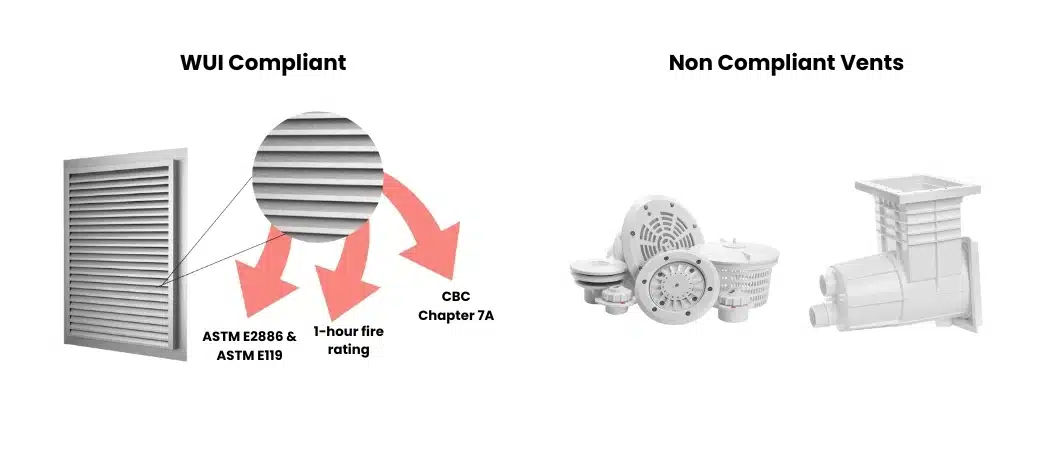
The mesh screen is the first point of contact for wind-blown embers. This single feature determines if a vent is safe or dangerous. Non-compliant vents generally use a coarse mesh, with openings of 1/4 inch or larger. These holes are big enough for burning embers to pass straight through. They act like a sieve, allowing embers to fall directly into your attic space.
On the other hand, WUI-compliant vents are built with a fine metal mesh. The openings are very small, measuring between 1/16 inch and 1/8 inch. This tight weave creates a physical barrier. It is designed to stop most embers at the exterior of your home, preventing them from entering and igniting combustible materials. Plus, WUI-compliant vents include a honeycomb matrix for an extra layer of protection for your home.
Vent Materials and Wildfire Heat Resistance
The material of the vent must withstand extreme radiant heat without failing. Non-compliant vents are often constructed from plastic or thin, untreated aluminum. These are weak choices. Plastic vents will melt when exposed to high heat, creating large, open holes that allow flames and embers to pass through. Plus, thin aluminum can warp, corrode, and fail quickly.
WUI-compliant vents solve this by using heavy-gauge, non-combustible metals. Stainless steel or thick, corrosion-resistant aluminum is the standard. These materials will not melt, burn, or become compromised under the intense conditions of a nearby wildfire. They maintain their structural strength to keep the protective mesh in place.
Fire Resistance and Testing
Any product can claim to be fire-resistant, especially in the wildland urban interface in California. Only testing provides proof. Non-compliant vents have no verified fire performance. They are not subjected to any standardized tests that simulate wildfire conditions. They are an unproven and unreliable component in your home.
For WUI-compliant vents, passing rigorous laboratory tests is mandatory. The primary standard is ASTM E2886. This test subjects the vent to continuous ember exposure and direct flame impingement. A vent that passes has proven it can resist both. This third-party certification is the only way to know a vent will perform as needed during a devastating wildfire event.
Wildfire Vents Code Compliance
The wildland urban interface in California is governed by strict building codes designed to save lives and property. Wildfire Vents Code Compliance is not just a suggestion- it is the law. Non-compliant vents are a direct violation of California’s Chapter 7A building code for homes in WUI zones. Installing them in new construction or during a major renovation is illegal and will result in a failed inspection.
WUI-compliant vents are the only legal option. They are specifically designed & certified to meet California’s Chapter 7A building code requirements. Using them is required to pass the final inspection and to ensure your project complies with state law.
The Mark of Certification
You should not have to guess if a vent is safe. The certification label provides immediate, visible proof. Non-compliant vents do not have an official fire safety label from a recognized testing agency. You will not find a certification mark on the vent itself or its packaging. Every WUI-compliant vent must have a permanent, legible label.
“CA SFM Listed” is the most common and recognized mark in California. This label is often stamped directly on the vent’s frame. Many now also include a QR code you can scan for instant verification. No label means the vent is almost certainly non-compliant and should not be used.
Additional Safety Features
Some vents provide an automatic layer of protection that goes beyond the mesh. Non-compliant vents offer no advanced safety features. They are simple covers with no secondary defense mechanism. Many WUI-compliant vents include intumescent material. This is a chemical compound built into the vent assembly. Under normal conditions, it remains inert.
When exposed to the extreme heat of an approaching fire, this material rapidly expands to many times its original volume. It swells to fully seal the vent openings, creating a solid barrier that blocks both embers and flames during critical moments.
Why WUI-Compliant Vs. Non-Compliant Vents Matter to You
The choice between WUI-compliant and non-compliant vents has direct consequences. First, it changes your home’s risk profile. Non-compliant vents are a documented ignition point, significantly increasing the risk that an ember will ignite a hidden attic fire. WUI-compliant vents are engineered to prevent that. Second, it affects your finances. Insurance companies actively inspect homes in high-risk areas. Non-compliant vents can lead to significantly higher premiums or even a canceled policy.
Installing compliant vents shows an insurance company you have taken a concrete, code-approved step to protect your property. Finally, it impacts your home’s value and salability in the wildland urban interface in California. A home with verified, code-compliant fire-hardening features is more valuable, and it provides peace of mind to future buyers.
Conclusion
Ultimately, the primary distinction between WUI-compliant vs. non-compliant vents determines your home’s defensibility. WUI-compliant vents, with their fine mesh, non-combustible materials, and third-party certification, create a proven barrier against ember intrusion. Non-compliant vents pose a significant wildfire risk.
At Vulcan Vents, we provide the advanced wildfire protection your home requires. Our vents are engineered to deliver excellent airflow and are made from materials that withstand extreme heat during wildfires. Our vents are California Building Code Chapter 7A-approved and officially listed by the State Fire Marshal (SFM). This certification is your guarantee, as each of our vents has successfully passed rigorous third-party testing, including ASTM E2886 for ember and flame resistance. Contact us today!

